The Embarrasingly Delayed Education of Ralph D. Winter

By Ralph D. Winter

(Note: Everything here represents either widely accepted scientific understanding or Biblical interpretations that are seriously believed by widely respected Bible scholars. Granted that some of these ideas may seem unusual, to my knowledge there is nothing here that can fairly be construed as heresy. Further explanations are at the end.)

What About The Gospel?

I could have and would have used the word “Gospel” in what follows were its meaning not highly reduced in common Evangelical usage. In the Bible the word does not refer merely to the heralding of good news but the coming of the Kingdom of God in this world. That is good news. It is also the implantation and extension of God’s will in this world. We read more than once in the NT about “obeying” or “disobeying the Gospel.” Even “hearing” the Gospel implies a yielding to God’s will, not just listening and assenting to the truth of a message.

Thus, to “hear” the Gospel means an acceptance of the lordship of Jesus Christ and vital, total involvement in the phrase of the Lord’s prayer, “Thy will be done on earth.” We see the same thing in the Great Commission’s “teaching them to obey all things I have commanded you.” All this implies the extension of God’s will on earth not just telling people how to get to heaven. Only if believers are known for both seeking and standing up for God’s will in all and every part of life can we properly glorify God. Otherwise we misrepresent Him. And, as a result our conversions are half way conversions that may not last or may not truly happen at all.

1950

Soon after 1950, when I was 26 years old, discussions at the level of the Wheaton College Board (following the views of Dr. Russell Mixter, Chair of Wheaton’s Dept. of Biological Sciences) came to a significant decision. The board determined that Wheaton faculty would be allowed to believe that the flood in Genesis was local, covering “the known world” but not the entire planet. Of course, once you speculate that Genesis did not necessarily refer to the entire planet, other new interpretations of the first few chapters of Genesis loom. In any case, in 1950 I had no knowledge of this decision at Wheaton. Neither did it occur to me that any Bible believer would take that position. I would not find out about Wheaton’s decision until thirty years later.

1958

Eight years after Wheaton’s decision, the widely respected department chair of Old Testament Studies at Dallas Theological Seminary, Merrill Unger, went into print (Bibliotheca Sacra, 1958) with a highly unconventional view of Genesis 1:1,2, namely, that Genesis 1:1 was a new beginning not THE beginning, that is, Genesis Chapter 1 is the beginning of the human story and not the beginning of the universe. But it was not until I was 80, 46 years later, that I typed into Google the words “before Genesis 1:1″ and thus learned of Unger’s point of view about “the geologic ages” occurring before Genesis 1:1.

1969

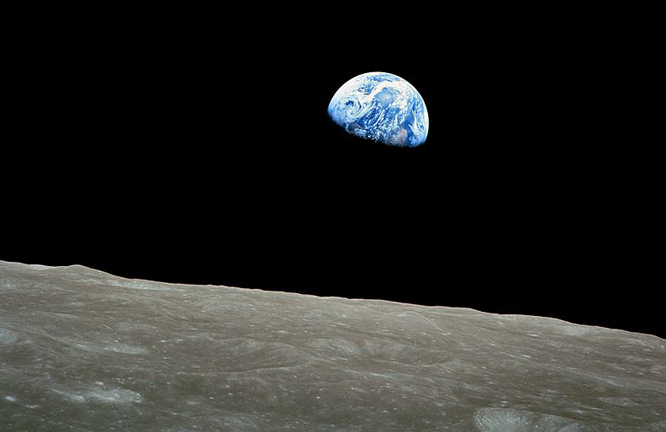
Then, it was in 1969, when I was 50, that the USA landed on the Moon. But it would be 28 more years, when I was 78, before I heard that what we found there included the fact that the numerous, quite visible Moon craters (unobliterated by weather or erosion) were actually asteroidal impact craters not volcanic craters—as had long been believed.

Now, in 2007, it has been 32 years since the Moon landing. Ever since then hundreds of scientists have been scouring the surface of our weather-swept earth for similar asteroidal impacts. Hundreds of huge craters have been discovered and thousands of smaller ones. Now, for example, many specialized scientists believe that the 100-million-year dominance of the dinosaurs was suddenly ended by the global turbulence created when a huge asteroid left a 100-mile wide crater in the Yucatan peninsula of Mexico.

Indeed, one study reported in Scientific American (March 2002) tells of the discovery of 45 impact craters at least 15 miles wide. Furthermore, it is understood that even smaller asteroidal impacts often darken the whole earth until, as the dust settles, first glimmers of light indicating light and day appear and later the Sun, the Moon and stars become visible—a sequence which, if that of Genesis, is a sequence of restoration not of creation.

Something very strange and puzzling but widely discussed by both paleontologists and evolutionists is the sudden and very wide diversity of life forms appearing in what is called the Cambrian period. That sudden, spectacular diversity is why this period is usually referred to as the Cambrian Explosion. Such an event obviously damages seriously the idea of a gradual Darwinian process.

However, where have I been? I did not to know until recently that a not-often-mentioned peculiarity of the Cambrian period, in addition to the very-often-mentioned sudden, un-Darwinian profusion of life, was the first appearance at that time of predatory, life-destroying life. I first saw this in National Geographic and later in technical books on paleontology. Was the Cambrian event the first clear evidence of C. S. Lewis’ “Hideous Strength”? More specifically, has the slow progression of increasingly complex life forms been the work of obedient angels—while the violent, predatory life forms have been the effect of angels whose rebellion caused the distortion and violence first appearing in the Cambrian Period? Is that why, when Satan appeared much later in the Garden, he already had a lengthy crime record? Did he “fall” whwn the Cambrian Period began 500 million years earlier, thus explaining the unremitting destruction, suffering and wildly diverse, violent animal life for the next 500 million years?

Back to Unger. His exegesis of Genesis 1:1,2 (along with C. I. Scofield and a host of other Bible expositors) proposes that v. 2 describes the result of some sort of a destructive event. Tohu wa bohu in v.2 could mean “destroyed and desolate” not merely “formless and void.” In that case such a destruction was the basis for the creative events in chapter one. Furthermore, notice that the text of Chapter 1 insists that both the animal and human life created at that time was not predatory or carnivorous. Hmm.

At What Point Humans?

Furthermore, paleohistorians and paleoneurologists may have a better idea of when truly human beings first appeared than ordinary paleontologists whose focus is fossilized bones. Paleoneurologists, in contrast, look to changes in genomics. Paleohistorians pay attention to evidences of unprecedented intelligence rather than to the sizes and shapes of bones. Paleohistorians have come to the fairly settled conclusion that both plants and animals began to be genetically engineered through highly intelligent selective breeding about 11,000 years ago. Recent articles (even Newsweek, Mar 19, 07) suggest that truly human forms appeared 50,000, or 37,000 or even 5,800 years ago. These are the dates when three unique genes first appeared that are apparently essential to true human beings.

The third of these unique genes, ASPM, clocked in at the 5,800-year date. Could ASPM be the unique “Edenic Gene” characterizing Adam’s stock in Eden? If so, this could mean that prior to Eden humans lacking this third gene were living all over the world. Widespread evidences are that such humans were vicious and carnivorous cannibals. Were some of them wiped out in an area of the middle east when the impact of a smallish asteroid initiated the events of Genesis?

If that happened, the later breakdown of the Edenic new beginning would have resulted in the interbreeding of the animal and human life of Genesis 1 with the already-distorted and carnivorous forms of life outside of the Garden of Eden. This would have caused a degradation of the unique “image of God” type of Edenic humanity (bearing the ASPM gene). That interbreeding would have meant both moral degradation as well as genetic distortion in the form of carnivorous behavior (Chapter 9) and the resulting steady shortening of life.

Keep reading; download the entire article now.